Sunday, 9 August 2015

Restaurant business and puerh tea

Even as old vintage puerh tea is in short supply today, ever wonder why there are still a sizeable amount of old puerh cakes around these days?

Old puerh tea cakes
Prior to 1970s, there was hardly any demand for old vintage puerh tea. Even in places like Hong Kong and Macau where morning dimsum type of breakfast was very common, most people if they ever drank puerh tea, they would only order loose puerh tea form the restaurants where they patronised their dimsum. In those days shops would only put on sale ordinary puerh tea usually artificially fermented in their warehouse under moist environment. As raw puerh tea was the only tea type on production, it was both harsh and undrinkable, most shops would store the tea in moist warehouse where the high humidity was ideal to age the green tea. This gave rise to the characteristic unpleasant (like decay wood) smell of puerh stored and aged under the wet and moist environment.
Assortment of tea in a tea shop

Restaurant owners in Hong Kong all the while knew that people of Hong Kong would always favour dimsum with Chineses tea and they needed to keep a large stock of puerh tea in their warehouses. As they knew that puerh tea was in a way like the old mandarin orange peel (skin of the  mandarin oranges), the older the thing the more pricey it was. Hence they had confidence in ordering large quantities of puerh tea and kept the tea in their warehouses. Mean time the people in Taiwan also ordered their puerh tea from Hong Kong with the unmistakable decaying smell (due to wet storage). Hence it was obvious that puerh tea was not popular among tea drinkers in general. The tea was considered sub-standard when compared to the fragrant green tea such as the Goddess of Mercy.

I also remembered in the early 1980s when I was looking at some puerh tea in a supermarket, my friend met me. He looked surprisingly at me and remarked that why I drank such a tea that tasted like decaying wood. I put on a smile and just said the tea was fine for me. This friend of mine liked the Wuyi mountain tea and he had often demonstrated his tea drinking skills to audience in major tea promotion events. Years later I met him again and he was complaining about the high price in aged puerh tea. He said he should have followed me in buying the tea when it was still unpopular in those days. When he finally realised the difference of really good puerh tea, the price had rocketed so much that it was beyond his ability to acquire such rare aged tea.

The early tea merchants in HK

In the 1980s, things began to change for the better for puerh tea. People began to appreciate good old puerh tea aged in proper dry warehouses where conditions favoured the natural ageing process. When people realised the big difference in quality between genuine puerh tea as compared to the one aged in moist environment (which picked up the decaying smell from high humidity and wetness from the warehouse), puerh tea was then accepted as a tea comparable to the famous goddess of mercy or the Wuyi mountain tea. At that time the price of vintage tea cakes was still high and most shops dared not order large quantity to sell as turn-over rate was too slow. One shop owner commented that he ordered some bundles of the Red Label puerh tea cakes and the order costed him hundreds of thousands of $HK. This amount of money could buy him a property in high end district in Hong Kong. Being raw puerh tea, the Red Label tea was till very harsh in taste and flavour. After one year he was only able to sell a few cakes. It is unthinkable now as each Red Label puerh tea cake can cost as much as several hundred thousand dollars. But again in the early 1970s, the tea was really too green and harsh to be accepted as good tea.

Red Label tea cake

Towards the end of the 1980 era, people generally appreciated good puerh tea from the aged old vintage tea cakes. But now the Red Labels had turned into a mature puerh tea with excellent taste and flavour (don't forget these tea cakes were made in 1950) after so many years of storage. Most of the Red Labels were shipped to Taiwan as they commanded a better price there. Taiwanese people had deep pockets those days due to their achievement in the electronic and computer industries.

What about the restaurant owners? If you remember, these were the people who partly helped the old puerh tea to gain its popularity as they had a very large quantity of raw puerk tea cakes stacked up in their warehouses. They kept the tea solely for their business model as dining in HK was inseparable from tea drinking. They could not comprehend the fact that their years of hard work in hoarding the puerh tea (again strictly for their restaurant business) could finally pay off. They were actually sitting on some huge fortune they previously could never imagine. Some restaurant owners began unloading the aged puerh tea in their warehouse and reaped huge profits. Other owners stopped their restaurant business and started selling also their stored puerh tea. They were astonished to find that the profit from the sale of the puerh was very much more than the restaurant business and the premises they sold. They were actually the people that hoarded such precious puerh tea of the past and kept the tea through these past decades. Most of these aged puerh tea cakes are now in Taiwan as the Taiwanese people were very acute in their business sense, With deep pockets and tea-drinking culture, Taiwanese people just cleared most of the aged puerh tea from the warehouses in Hong Kong. Now, as the Chinese people become affluent, most of the aged puerh tea cakes again find their way back to mainland China. Very previous old tea even find its way in auction houses in China. This is the craze for good aged puerh tea in China.


Aged compressed puerh tea

Aged puerh tea cake

Ancient puerh brick

Old stone mould used to compress puerh tea

A tribute to tea produced from Qing emperor

Ancient puerh tea factory

Monday, 3 August 2015

Tea bricks

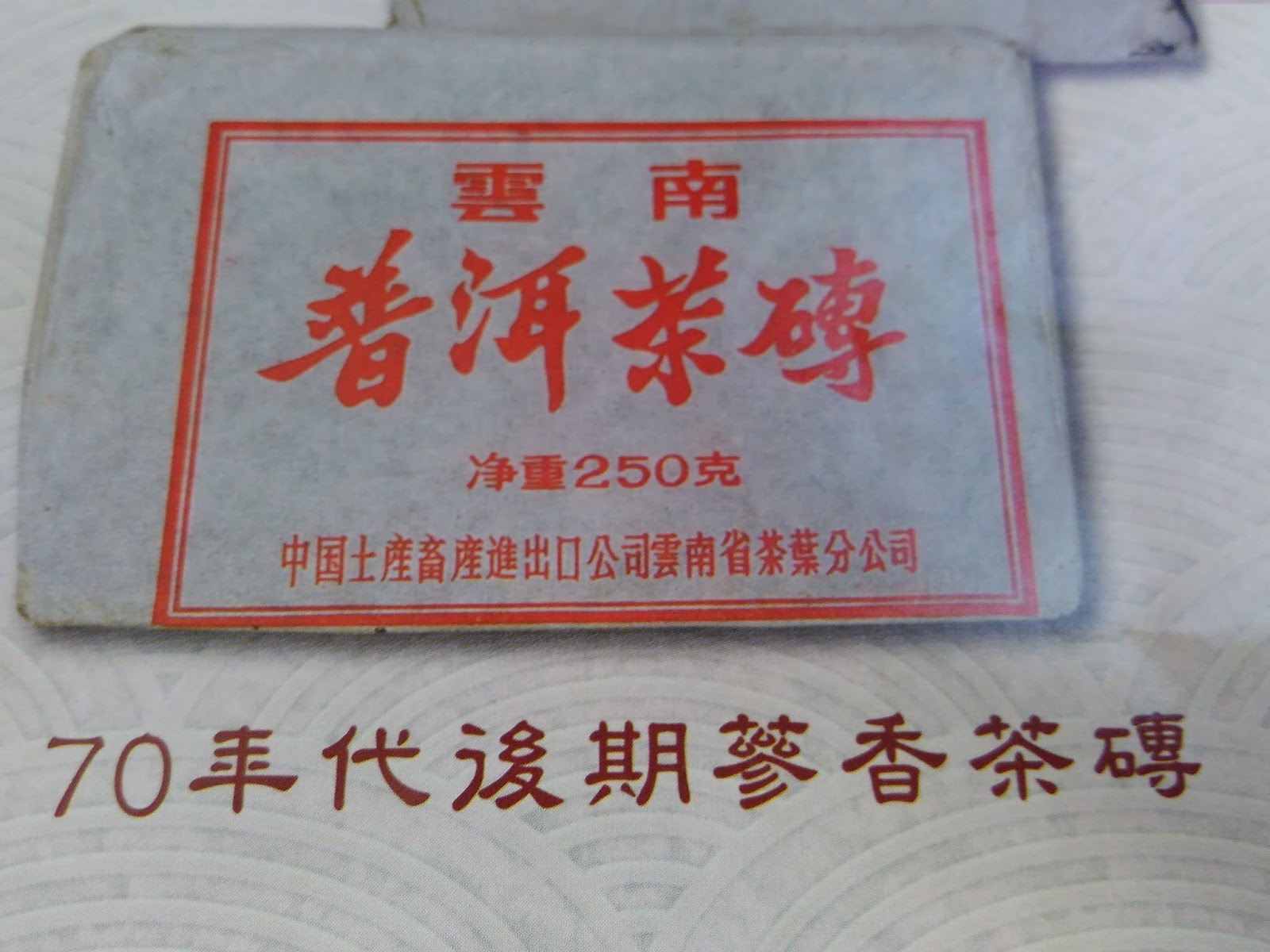
Since 1967, the making of compressed tea developed into a new phase. The shape of compressed puerh tea eventually took the form of a brick weighing 250 g.  The reason to have the compressed puerh tea made in the form of bricks was simple. It was all about stackability. Just like in an aircraft, things have to be designed with stackability in mind due to space limitation. For maximum storage capacity, puerh tea is compressed in the form of bricks so they can be stacked easily. These tea bricks can be easily put in boxes for transportation or storage.


In the 60s which was the period of Cultural Revolution in China, there was a batch of puerh tea bricks made entirely from green tea processed into the so-called raw puerh tea. These tea bricks carried the inside sticker bearing characters of the Cultural Revolution Committee. This particular tea type is really a gem in the eyes of the collectors. However, there are plenty of fakes in the market.


In 1973, Menghai Factory introduced the formula to make cooked puerh tea. The factory successfully produced cooked puerh tea where the ageing of the tea was remarkably shortened by an artificially controlled ageing process. Towards the end of the Cultural Revolution, Menghai Factory produced another famous batch of puerh tea bricks where a mixture of raw and cooked puerh tea leaves were used in the recipe. This became what is known as the 7562 tea bricks. This tea type is highly sought after by tea collectors due to its excellent quality.


Yet another famous tea bricks produced by Menghai Factory is the 1973 thick-brick (due to the thickness of the slab) where mixture of raw and cooked tea was used in the recipe. These bricks were bundled in a brownish rope. The 73 thick-bricks are considered very good tea due to the success of blending raw and cooked puerh tea to make them. It has a deep soothing flavour and a fragrance resembling age old herb with the characteristic of Chinese medicine. Unfortunate such good tea is in short supply due to heavy consumption by tea drinkers over the years.

A rare gem of the puerh tea

Bricks made in the late 70s
With success in making cooked puerh tea, Menghai Factory continued to experiment and make large batches of puerh tea bricks using blended puerh tea leaves and improved methods. Puerh tea bricks will continue to be a force in the puerh market.

500 g puerh brick
I personally like puerh tea bricks as it is easier to stack them in my store room for long term storage. The size of 250 g is also ideal for consumption.

Tuesday, 28 July 2015

What is in the number 7542

You probably have heard of 7542, 8582, 7452, 7562, 7581, 7653, 7633, 7643, 8653, 8663, etc. The first 3 sets of numbers may sound familiar and the last few may be unheard of.

These are all puerh tea cakes made according to some recipes or formula. The first 2 set of numbers represent two very popular puerh green tea cakes while the third is a puerh cooked tea.


7542 green puerh made in 2003
After 1950, the making of puerh tea in China came under the control of the state. There were 3 state-run factories involved in the making and marketing of puerh tea. These are the Kunming Tea Factory, Menghai Tea factory and Xiaguan Tea factory. The management of these factories met and agreed to use certain set of numbers to represent the tea each factory produced. The last digit of the 4 numbers represent the factory the tea was made, the first 2 digits were the year and the 3rd digit was the grade of the tea leaves used.

The last digit 1 was used to represent Kunming Tea Factory, 2 for Menghai Tea Factory and 3 for Xiaguan Tea Factory. Hence 7542 puerh tea cake was used to mean that the tea was made in Menghai factory in 1975 using grade 4 tea leaves. 7581 tea cake meant the tea was made in the Kunming factory in 1975 using grade 8 tea leves and 7633 tea cake was made in the Xiaguan factory in 1976 using grade 3 tea leaves. This seemed to be a fantastic idea to distinguish puerh tea cakes produced in different factories. But the initial implementation of this method of identifying tea products met with confusion and inconsistencies.

Menghai Tea Factory
Today you will find the Menghai factory still makes puerh tea cakes using the label 7542 or rather follows the original recipe of 7542 to make the puerh tea cakes. Why?

The legendary 88 green cake is a 7542 cake
The reason is simple. The 7542 raw puerh tea cakes are well received by tea drinkers. Some of the earlier batches of 7542 tea cakes are very costly, like the 88 green cakes (7542 made in the late 80s) which are the darlings of the 7542 puerh cakes. Due to popular demand, the Menghai factory continues to churn out large quantity of 7542 puerh tea cakes. Eventually the 7542 cakes become the industry standard. Hence you will find  the 7542 tea cakes made in the 80s, 90s and 2000s as well. Tea collectors know that the 7542 tea cakes are hot favourite, so many stock up the tea cakes in anticipation of a price hike.After the 7542 tea cakes, the 8582 puerh green tea cakes are the next most popular raw puerh tea cakes. Collectors also start putting their money in the 8582 tea cakes. They also stock up large quantities of 8582 tea cakes waiting for the price to appreciate in the years to come. Now these numbers like 7542 and 8582 are more like recipes where tea factories follow in making their tea. They have lost the original intention of distinguishing the tea in terms of year of production, the factory and the grade of tea leaves used. Moreover the Kunming Tea factory ceased operation many years ago. With new tea enterprises emerging in the market, some will just use their trade marks or tea labels. Only Menghai and Xiaguan continue the tradition of using these well-known recipes to make tea.

7581 bricks made in Kunming Tea factory


Another famous tea is 7562, the bricks made before the end of cultural revolution in the 1970s. The factory later also produced little square puerh tea bricks (100g weight) following the 7562 recipe. These are tea worth collecting due to their remarkable quality.


Sunday, 26 July 2015

Interesting Puerh Tea Wrappers

Just as diversified as the shapes of compressed puerh tea, the wrappers used to wrap up the puerh tea cakes are both complex and interesting.

Prior to privatization, the tea manufacturing was controlled by the state. There was collective purchasing of raw materials, tea production and export by state owned enterprises. The tea labels and wrappers mainly depicted the character Cha (Chinese for tea). The printing of Cha  was in different colour to denote the different batches produced. The most valuable is the Red label, then the green, followed by the yellow label.
Green label
Yellow Labels

Red Label tea cake

New product also featuring the character Cha

After tea manufacturing was privatized in 2004, there was a surge of private enterprises engaging in the making and marketing of puerh tea. There was a  craze for puerh tea (where prices jumped a few hundred percent), both for consumption and collection. This craze lasted couple of years until the climax in 2007 followed by the unexpected crash shortly where prices of puerh tumbled. Prior to the crash, there was such a great variety of puerh products in the market. These tea products, be it cakes , bowls or bricks, were fascinating in terms of labels and wrappers.

The wrappers on the puerh cakes were exciting. The manufacturers designed and printed the wrappers using various themes and ancient stories to promote their tea products. Stories from the Romance of the Three Kingdoms were use to produce tea wrappers. Hence, you see ancient generals like Guanyu, Huangzong, Zhouyun, etc, featured on the puerh cakes. The strategist Zhugeliang also appeared very often in these tea wrappers. Of course the legend had it that Zhugeliang was the person who first started the puerh cultivation in Yunnan as he used the tea to cure his soldiers suffering from sickness in this part of China while he was establishing a foothold for his boss, Liubei of the Shu Han.
Zhaoyun, a famous war general


The master of strategies, Zhugeliang

Guanyu, a famous general of Shu Han
The use of such wrappers that tell the stories of the era during the Three Kingdoms period had its motive. If you like the characters of the Three Kingdoms, undoubtedly you would collect all the tea cakes that were on offer. Moreover collecting puerh tea was known to be rewarding, as its prices escalate overtime. This reminds us of stamp collecting. Once you collect certain type of stamp, you will end up collecting all the stamps of that nature. The tea producers would then see a market need for their products. A very clever strategy, like a scheme devised by the legendary Zhugeliang in the story of Romance of the Three Kingdoms.

Other theme also focused on native villagers harvesting tea leaves, processing tea or making tea. The wrappers were exquisitely designed and printed. This makes you want to collect them the way you collect art pieces. If you collect all these tea cakes, you might even want to open an art gallery to show off your collection. This is tea mingling with history and art.


Tea production
Beautiful oriental ladies also commonly featured in the tea wrappers as a means to attract buyers.


There was even one tea producer capitalizing on the famous tea mountains of Yunnan to sell his products. He had all the famous 6 mountains in Yunnan printed as tea wrappers to market his tea. Maybe his aim was to promote his tea as coming from the famous tea producing regions of Yunnan. In case you still do not know the famous tea regions in Yunnan, it is good to take a hard look at the labels. On hind sight, this may be good for tea drinkers as they were educated or reminded of these renown tea regions while enjoying their favourite cup of puerh tea. But then who would want to open up the wrappers to consume the tea if the wrappers were so pretty and artistic.


The famous tea regions of Yunnan
There are just too many different types of puerh tea wrappers in the puerh trade. If you start to collect them, you might end up with a wonderful collection. This is puerh tea culture, history, art and tea in one. You can start an art gallery to showcase your collection.


The horse gang Ma Bang

Zhugeliang with his feather fan

Unfortunately, I did not indulge in this craze for I do no have a deep pocket. Also it was not possible to hunt for this tea products as not all the tea importers share the same view. If they do not import a complete set of tea products with all those designed wrappers, then there is no way you can have a good and complete collection.