Monday, 10 April 2017

Old Singapore Money

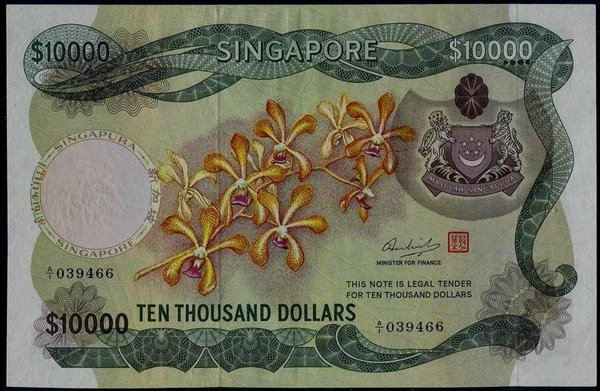
One dollar note
This is the old Singapore currency used in the early days after independence, the famous orchid series of currency notes from one dollar denomination up to 10000 dollar denomination. The one dollar, five dollar, ten, fifty and hundred dollar notes are more common whereas the twenty five dollar notes are not so common. The thousand dollar notes  are now worth more as these big notes are seldom in circulation, they are quite rare.

These orchid series currency notes are well liked by Singaporeans as the notes are well designed and pleasing to the eyes. I collected quite a few of them and would not want to spend them in excange of things.

The notes are still affordable if you want to collect them. Any one upto hundred dollar notes are still within the means of an average Singaporean. 

Five dollar note

Ten dollar note


Saturday, 8 April 2017

Old tea

Recently I found some old puerh tea in my store room. I must have bought them many years ago. There is a purth brick where the tea label had faded. I have no way to tell what was written on the tea label. Judging from the size of the tea leaves, it must have come from a puerh tea tree.

There is this puerh toucha. The square label zhong character can be seen clearly. As the label is smaller than those found on thd toucha made in the 1980s, I guess this type of toucha could well be from the 1960s.


A teapot for brewing tea

Recently I went with a colleague to hunt for some crystal carvings and spotted this teapot diaplayed at a nearby shop. I used to own such a teapot many years ago but sold it to a friend who happened to like the unique shape of this teapot. Since then I wanted to buy back this type of teapot but was not able to find one.

This was an opportunity and I would definitely make enquiry on price, etc. Fortunately, it was not that expensive so I bought it.


This teapot belongs to the type of teapots made by  joining segments of clay together. The segments are separated by glooves that bring out the shape of the pot. It is elegant and well made. When I pour tea out from the pot, tea just flows out from the sprout without wetting the pot.

A similar teapot made in Qing Dynasty is now on display in a museum in the United States. It was made in such perfection that it is a delight to its owner.

In a museum in the United States

I have other teapots made in this manner. Their artistic forms are just good  for tea drinkers to admire.


Friday, 24 March 2017

More Chicken blood stones

I have a bigger piece of chicken blood stone which I bought a few years ago. It is not the best of the chicken blood stones but at least something I can afford. It sits on a piece of Qintian stone carving which also served as a stand for the chicken blood stone. This is a raw stone with no carving on it. I will just have to admire the splashes of red hue on the stone and paid a fair bit of money for that. I regretted not buying any chicken blood stones when the price was low. These stones are lovely to look at, especially those with carvings done by masters.


This screen was carved from a huge chicken blood stone that exhibits three distinctive colours, yellow, red and black. The master carved out the story of Romance of the Three Kingdom. The 3 famous generals, Liu Bei, Guan Yu and Zhang Fei; Liu Bei the yellow face general, Guan Yu the red face general and Zhang Fei the black face general. He later sold it to a collector for 5 millions. Now this piece is worth over 50 millions and the owner even refuses to sell it. He commented it is hard to find such a big stone with a master's work on it. Below is the picture of the screen.

A big screen with the story Romance of the Three Kingdoms on it

The three generals became sworn brothers and went thru thick and thin in battle
Here are some exciting raw stones, seals and stone carvings. There are guidelines in selecting a good chicken blood stone for investment. If you have the cash, look for the best.


Add caption
To choose a good chicken blood stone, the colour must be bright red, and the patches of red hue must be lively. It should resemble fresh blood flowing out, or splashing onto the stone. The background (or ground in short) should also be stone of good quality, clear and translucent, the colour should preferably looks like that of the horn of a cow.

The flow of the red hue is lively, like Chinese art


Colour and ground both excellent


A huge raw stone that is worth millions of dollars

Red mountain

Sunday, 19 March 2017

Chicken blood story

Recently I spotted this carving of chicken blood stone in an art-n-craft shop. This stone has splashes of red hue that resembles chicken blood on the surface, hence the name chicken blood stone.  The carving of the stand also looks good and skillfully made.

A small carving of chicken blood stone
Chicken blood stones are sought after in the world of seal stones and carvings. With its attractive chicken blood colour on the surface, people of China have been using this stone as the material to make seals. Some seal stones with more than 70% of the surface covered with red hue are considered rare and cost a lot of money.

When China established diplomatic tie with Japan, Premier Zhou Enlai presented a pair of seal stones made from chicken blood stones. When US President Reagan visited China, he was also presented with seal stones cut from chicken blood stone. You can see the value of this stone to the people of China.
Zhou Enlai meeting with Japanese PM

Full body red seal stones presented to Japanese PM


There is a trader who later turned into a vivid collector of chicken blood stones. He owns a museum where he exhibits numerous artifacts made of chicken blood stones, from seal stones, large carvings to huge raw stones.
A huge raw stone in the museum
There is an interesting story as to why from a trader of chicken blood stones, he became China's well known collector of chicken blood stones.

He is a native of Qintian (place famous for Qintian seal stones) and started off as a trader in Qintian stones. When he first saw the beauty of the chicken blood stones, he switched to selling these and started making handsome profits. It was $30 per kg and later went to as high as hundreds of thousands per kg as the supply dwindled.

In early 1990s, he bought a raw stone for $20,000 and he bought a save and kept it there. 2 years later, a friend offered him $200,000 for the stone.

A raw stone kept in the save 
As a trader, he was happy to see that his investment paid off. He took his friend to his house to see the stone. Unfortunately he could not find the key to open the save. He thought that he could have lost it when he moved house some time ago. Since he couldn't retrieve the stone, the deal was off.

A few years later another friend offered him 2 million to buy the stone. He suddenly realized that these stones have great value. He then got a technician to have the save cut opened. He retrieved the stone and started to admire the splashes of red hue on the surface, the mystery of the chicken blood. He decided not to sell the stone. He even started to collect them in large quantities.

He even kept the cut-open save in his bedroom to remind him that these stones are worthy to collect.


To make money in the 1990s, he sold a lot of quality stones to collectors in Taiwan. He started to buy back these stones he sold to Taiwan. Of course he had to pay large sum of money for buying back  the stones.
Stone he bought back from Taiwan
He once had a huge stone where he engaged artist to carve a hundred horses on it. At one time, he was heavily in debt. When he exhausted his ways to find fresh cash to pay his debt, he cut 2 thirds of the stone and sold it to pay his creditors. He managed to get back a hundred million to settle his debt. Now, he is still in possession of the other 1/3 of the stone but it has only 8 horses on it.

8 horses carving

Monday, 13 February 2017

Stone carvings

I love stone carvings.

Ever since I bought my first piece of stone carving, I fall in love with stone carvings. It is a basket full of Yangmei, a type of oriental fruits that make you mouth watery. My visitors almost reached out for the fruits as if they were real. Thanks  to the skills and creativity of the master carver. Later I bought another stone carving which is a basket-full of lychees. This time my grandchildren wanted to pick the fruits from the basket.

I admire the intelligence and skills of the stone carving artists who can turn ordinary stones into beautiful art pieces. Stone carving is an interesting art form. The artists study the stones well before they start work to create the masterpieces based on the texture and colour distributions in the stones. Sometimes a stone may seem to have a lot of imperfections on it but the craftsman can turn these defects into marvelous objects that can enhance the theme of his master piece.

My first piece of stone carving
A basket of lychees

For instance, there was a raw stone that had some black patches on it and the craftsman skillfully carved it into the face of a African leader who was seen seated beside Chairman Mao during the latter's state visit to China.

What a contrast of colour in this carving

Here a seemingly worthless stone with little good quality material could be turned into a masterpiece. It all depends on the creativity of the craftsman. He craved the quality part of the stone into bunches of grapes while leaving the majority part of the bad stone as background.

Grapes hanging on rocks
Stone carvings are beautiful pieces of art. Due to the scarcity of raw materials, these carvings are quite expensive to acquire. If they are carved by grand masters, it is almost beyond the ability of the average collectors to buy and keep them.


And this piece is priceless.
Impressive work of art - not for sale


A carving of Mei Lanfan

Mei Lanfan was a great opera singer.

A jade carving master wanted to create an art-piece to commemorate his birth. Very soon, there would be a celebration to honour the singer 120 year of his birth. As he was a great fan of the singer and he was skillful in jade carving, he wanted to carve something out of jade that could bring back fond memory of the great singer. Also he wanted it to be in time for the celebration

He began searching for the raw material in the jade market to create this masterpiece. He searched for a long time and yet could not find a suitable raw stone that could fulfill his dream.

Mei Lanfan, the opera singer
One day he stumbled upon a raw stone in the jade market. This is a piece of hetian jade ( a type of previous white jade) with some golden colour skin attached to it. Maybe this was the raw material he had been trying to find to carve and accomplish the task. He bought the stone from the vendor.

A fine precious raw jade stone
After buying the raw jade stone, he needed a theme to carve something that best described the artist. However hard he thought, he was not able to think of a theme. He needed inspiration badly as making something to commemorate this great opera singer was not a small task. Although the piece of jade was of very fine quality, the theme was equally important. Since he was a national master in jade carving, he could not simply carve something of inferior meaning, it had to be of divine nature in the subject area.

Day and night, he began to listen to the recordings of the singer in his study room. He was in need of some inspiration and yet he could not rush things. He had to let go and search in deep spirit for a theme. Suddenly when he was listening to certain portion of the opera songs on "drunken Guifei" (Mei Lanfan was famous for his role as Guifei in the opera), an idea struck him. He finally found the theme, the drunken Quifei. Yang Quifei was the Tang emperor's most adorable concubine that the emperor had to kill in order to quash a rebellion. The tragic love story between the Tang emperor and Yang Quifei can be found easily on the internet.


The artist listening to Mei Lanfan's records

Immediately he started work on the theme and produced some sketches and later transferred the theme onto the raw stone. The theme showed a pretty concubine with a Chinese fan half covering her face and a head gear with pearls on her head.

A fine sketch of the theme, Guifei portrayed by Mei Lanfan


Slowly and meticulously, he began work on the task of creating this masterpiece. He could not afford to make any mistake or else this would tarnish his work and the jade could be damage.

Work begins on the theme

Slowly and surely his work took form as he worked painstakingly to accomplish the task. One could see the image of the subject area appearing on the raw stone. He left the golden colour of the skin for the fan and the head gear of Guifei, the concubine.


The subject slowly takes form


After months of hard work, he eventually completed the task. A great masterpiece was created to the opera singer and his role as Guifei in his opera song. The jade was polished to a brilliant shine that reflected the quality of the material he chose for his masterpiece.

A final masterpiece

The jade master was satisfied with his work. He held the jade carving in his hand and kept admiring his creation. Nothing can describe his joy and sense of achievement.

One would think that he would sell his masterpiece to reap a huge profit or send it to the auction market where many people were eagerly sought after his works. With his fame and the grand-master title behind him, this masterpiece would fetch a very high price in auction.

The following day after he completed the jade carving, there was a celebration to commemorate the 120 years of the singer's birth. Immediate he set off to the house of the singer's descendant. On seeing the descendant of the opera singer, hg presented the carving to him as a gift to honour Mei Lanfan. The descendant happily accepted the gift and promised to place it in an museum that housed things of the opera singer.

Click here for more info on Yang Quifei and her tragic love story https://en.wikipedia.org/wiki/Yang_Guifei 
and for Mei Lanfan, the opera singer
 https://en.wikipedia.org/wiki/Mei_Lanfang